

When I first put together a list of SinoAfrica documentaries in 2016, the field was still relatively small. There were already more than a dozen films about Chinese people in Africa and Africans in China, but the available visual archive reflected some fairly obvious inequalities in who got to look, narrate and represent. An overwhelming proportion of the documentaries circulating internationally had been produced by Western filmmakers and broadcasters. At the time, I suggested that a distinctly Eurocentric gaze still had a fairly firm grip on the emerging SinoAfrica documentary universe.
Ten years later, the landscape is considerably richer.
Western television and independent documentary remain part of the picture, but they now sit alongside films by African and Chinese directors, African–Chinese collaborations, independent documentaries, feature films, shorts and works that deliberately blur the boundary between fiction and documentary. The subjects have expanded too. Alongside infrastructure, mining and the perennial question of whether China is “colonising Africa,” we now find films about African traders in Guangzhou and Yiwu, Chinese migrants in Lesotho and Angola, interracial families, factories, racism, women traders, digital media, industrialisation and the much less spectacular business of simply trying to make a life somewhere between Africa and China.
This is not intended to be exhaustive. It is an evolving archive of some of the films that have shaped—or complicated—the ways Africa–China encounters have been represented on screen.
Documentaries
African Boots of Beijing — Luke Mines and Jeremy Goldkorn (2006)
Africans in China
One of the earliest documentaries about African everyday life in contemporary China. The film follows Afrika United, a football team composed of Africans living in Beijing. Football provides an entry point into friendship, migration and community formation at a time when African presence in China had attracted relatively little sustained media attention.
When China Met Africa — Nick Francis and Marc Francis (2010)
Chinese in Africa
Still one of the strongest introductory documentaries on China–Africa relations. Set in Zambia, the film follows Chinese managers and entrepreneurs alongside Zambian workers and political actors. Its strength is that it largely stays close to the everyday negotiations through which “China–Africa relations” actually happen rather than treating China and Africa simply as two geopolitical blocs meeting one another in the abstract.
Empire of Dust — Bram Van Paesschen (2011)
Chinese in Africa
Set around a Chinese road-building project in the Democratic Republic of Congo, Empire of Dust centres on the relationship between Chinese manager Lao Yang and Congolese interpreter Eddy.
Slow, observational and frequently funny, the film is particularly good at capturing mundane misunderstandings about language, work, authority and expectations. More than a decade later, it remains one of the most memorable portraits of the everyday SinoAfrican workplace.
The Chinese Are Coming — BBC / Justin Rowlatt (2011)
Chinese in Africa
BBC correspondent Justin Rowlatt travels through Africa and elsewhere examining China’s expanding global economic presence. Its sections on Angola and Tanzania introduce Chinese entrepreneurs and businesses through the larger question then dominating Western media: what happens if China becomes a global economic power capable of challenging the West?
Viewed today, the documentary is also an interesting document of the early-2010s fascination with the idea that China had suddenly “arrived” in Africa.
King Cobra and the Dragon — Solange Guo Chatelard and Scott Corben (2012)
Chinese in Africa
Made for Al Jazeera’s People & Power, the film follows China–Zambia relations around Zambia’s 2011 presidential election. Opposition leader Michael Sata—“King Cobra”—had made Chinese investment, labour practices and migration politically contentious issues.
Rather than treating Chinese people in Zambia as a homogeneous extension of the Chinese state, the documentary encounters workers, entrepreneurs and migrants occupying very different positions within Zambian society.
The Africa China Connection — Pieter van der Houwen (2012)
Africans in China
One of the earliest documentaries to reverse the more familiar direction of the China-in-Africa story and ask why Africans were increasingly travelling to China.
The film is interesting partly because its Western perspective is so visible. African migration towards China becomes a lens through which to contemplate Europe’s declining attraction and increasingly fortified borders. Achille Mbembe and Ian Goldin contribute reflections on changing migration geographies. The film raises useful questions about mobility, even if its fly-in/fly-out perspective sometimes tells us as much about European anxieties as it does about African lives in China.
The Battle for Africa — Al Jazeera / Sorious Samura (2014)
Chinese in Africa
This two-part documentary begins with the familiar language of a new “battle for Africa,” in which growing Chinese economic power challenges established Western interests.
Sorious Samura complicates that framing by redirecting attention toward African political institutions and asking who ultimately determines how foreign capital affects African societies.
China Remix — Melissa Lefkowitz and Dorian Carli-Jones (2015)
Africans in China
A short documentary about Guangzhou’s African music scene, following three African musicians trying to build careers while navigating immigration rules, employment restrictions, friendships and family relationships.
Its emphasis on music and cultural production remains important. At the time, representations of Africans in Guangzhou were overwhelmingly organised around the figure of the trader. China Remix showed another African Guangzhou.
African Business in China — Al Jazeera Witness / Arnaud Zajtman (2015)
Africans in China
This film follows Congolese entrepreneur Nathalie Fodderie during a buying trip to Guangzhou as she searches for equipment for a restaurant in Kinshasa.
Through Fodderie’s negotiations with African intermediaries and Chinese traders, the documentary provides an accessible view of the commercial networks connecting Guangzhou with African cities. Its focus on a Congolese woman was also significant at a time when media accounts of African trading communities in Guangzhou disproportionately focused on Nigerian men.
Faces of Africa: When Chinese Meet Zambians — CCTV (2015)
Chinese in Africa
Part of CCTV’s Faces of Africa series, this episode looks at Chinese lives in Zambia and at the longer histories connecting the two countries.
It is useful to watch alongside Western documentaries from the same period precisely because the narrative frame is different. China–Africa relations appear less as the arrival of a threatening new power and more through histories of cooperation, migration and individual encounter.
中国人在非洲 / Chinese in Africa — CCTV (2015–2016)
Chinese in Africa
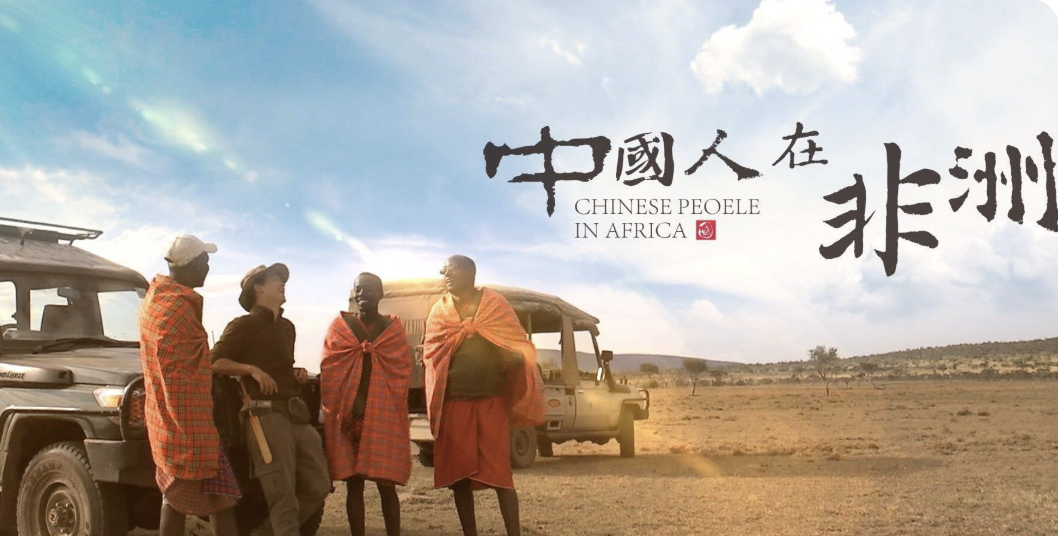
A Chinese documentary series following Chinese people living and working in different parts of Africa. When the original version of this list appeared, Chinese-produced documentary accounts of Chinese migration to Africa were still relatively difficult to access outside China.
China in Africa — VICE / Isobel Yeung (2016)
Chinese in Africa
For this VICE report, Isobel Yeung travels through the Democratic Republic of Congo, Kenya and South Africa examining infrastructure, resource extraction, business and Chinese migration.
The programme belongs recognisably to the mid-2010s wave of international reporting organised around China’s rapidly expanding economic presence, but it attempts to connect those macro-level debates with the workers, entrepreneurs and communities encountering Chinese investment on the ground.
Guangzhou Dream Factory — Christiane Badgley (2017)
Africans in China
When this list first appeared, Guangzhou Dream Factory was still in post-production. Released the following year, it became one of the most substantial documentaries devoted specifically to Africans in Guangzhou.
Following men and women from Cameroon, Kenya, Nigeria and Uganda, it explores migration, entrepreneurship, visas, aspiration and the sometimes elusive promise of “Made in China” capitalism.
我从非洲来 / Africans in Yiwu — Zhang Yong and Hodan Osman Abdi (2018)
Africans in China
A particularly important shift in the visual archive. Co-directed by Chinese and African filmmakers, the series focuses on Africans living in Yiwu through stories about education, commerce, marriage, food, public life and the arts.
Just as importantly, African participants are given considerable space to narrate their own experiences rather than appearing primarily as objects to be interpreted by an external narrator.
TAZARA: A Journey Without an End — Zhang Yong (2019)
China–Africa histories
This three-part documentary revisits the Tanzania–Zambia Railway, one of the most symbolically important projects in the history of China–Africa relations. Rather than treating TAZARA simply as an artefact of 1970s Chinese aid, the film follows the railway through the lives of the communities that continue to depend on it.
The project combines archival history with contemporary travel along the railway and interviews with people involved in its construction and subsequent life.
Na China — Marie Voignier (2019)
Africans in China
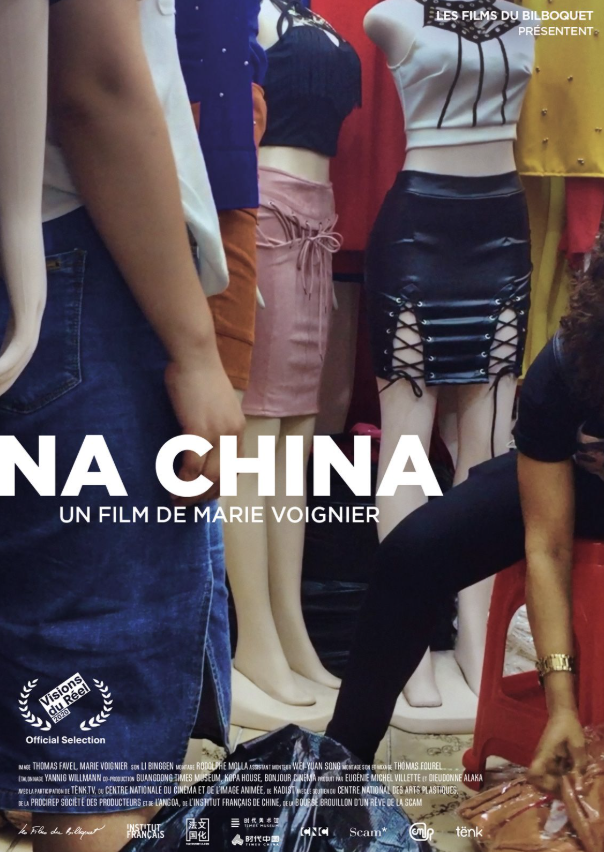
Filmed in Guangzhou, Na China follows African women imagining and developing business projects connecting Chinese commodity markets with African consumers.
Its attention to female traders is important in a visual archive in which the generic “African trader in Guangzhou” had long been imagined as male. Voignier also complicates documentary realism itself by incorporating actors and staged elements into a film that otherwise resembles observational documentary. Questions about authenticity, legality, value and representation are deliberately left unresolved.
Days of Cannibalism — Teboho Edkins (2020)
Africans in China / Chinese in Africa
One of the more formally ambitious films in this archive. The documentary begins briefly with African mobility in Guangzhou before moving to Lesotho, where Chinese migrants and Basotho communities negotiate a changing commercial landscape.
Edkins borrows elements of the Western—frontiers, cattle, traders, strangers and uneasy coexistence—to make a film considerably stranger and more interesting than the standard television question of whether China is “good” or “bad” for Africa.
Security Kingdom — Ni Ready (2021)
Chinese in Africa
This short documentary follows a Chinese businessman in Angola who creates a security company employing local workers to protect Chinese factories and other investments.
Behind the apparent success of his private “kingdom” lies a more precarious story involving insecurity, stranded capital, separation from family and uncertainty over whether to remain in Africa or leave. The film was selected for the 2021 Beijing International Short Film Festival.
Bobby’s Factory / China-Africa Factory — Zhang Yong (2021)
Africans in China
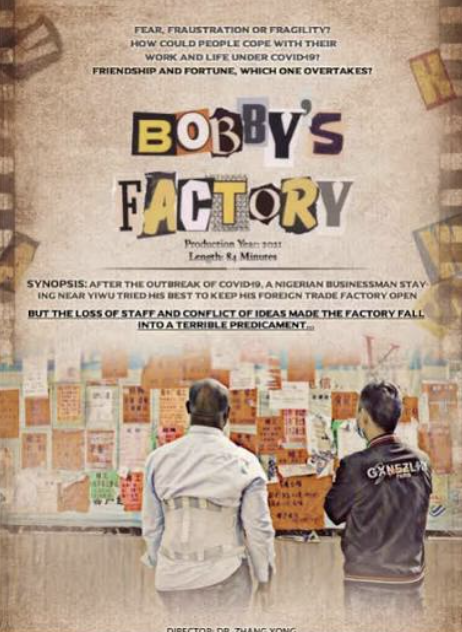
Bobby is a Nigerian entrepreneur who has lived in China for more than a decade and runs a cosmetics factory near Yiwu with his Chinese wife, producing goods primarily for West African consumers.
Filmed around the COVID-19 crisis, the documentary follows the factory through labour shortages, export problems and disagreements between management and workers. What makes the film particularly interesting is its reversal of a familiar China–Africa image: the African is the factory owner and the employees are Chinese. Yet the film does not turn that reversal into a gimmick; the precarious lives of the Chinese workers remain part of the story.
Racism for Sale — BBC Africa Eye / Runako Celina and Henry Mhango (2022)
China–Africa digital media
One of the most disturbing documentaries in the collection.
BBC Africa Eye investigates a video-production economy in which African children were filmed repeating personalised messages in Chinese, including explicitly racist material they often did not understand.
The documentary moves Africa–China representation into another terrain: platform economies, digital circulation and the monetisation of racial imagery.
Chinese Meet Africa / 我到非洲去 — Zhang Yong and Liang Zi (2022)
Chinese in Africa
This five-part documentary series reverses the direction of Zhang Yong’s earlier work on Africans in China. Filmed across twelve African countries, it follows Chinese people engaged in business, public-interest projects, art and everyday life and asks what it means for Chinese migrants to attempt to live within African societies rather than merely work temporarily on the continent.
Eat Bitter — Pascale Appora-Gnekindy and Ningyi Sun (2023)
Chinese in Africa
Set in the Central African Republic, Eat Bitter follows two men positioned at different points in the same construction economy: Thomas Boa, a Central African sand diver, and Jianmin Luan, a Chinese construction manager.
Both perform difficult and precarious work in pursuit of better futures for their families. Co-directed by a Central African and a Chinese filmmaker, the film is particularly effective because neither protagonist is required to stand in for his entire country. China–Africa relations emerge instead through labour, family obligation, vulnerability and aspiration.
Generation Z’s China-Africa Stories — Zhang Yong (2023)
China–Africa encounters
Part of Zhang Yong’s longer documentary project on grassroots China–Africa relations, this series shifts attention toward younger generations and contemporary forms of intercultural encounter. It forms part of a growing body of Chinese documentary work attempting to move China–Africa representation away from governments and mega-projects and toward individual lives.
Made in Ethiopia — Xinyan Yu and Max Duncan (2024)
Chinese in Africa
Filmed over four years around a major Chinese industrial park in Ethiopia, Made in Ethiopia follows three women: a Chinese factory director pursuing expansion, an Ethiopian factory worker hoping industrial employment will provide mobility, and a farmer confronting the transformation of the surrounding countryside.
The documentary avoids producing an easy verdict on Chinese industrialisation. Development emerges instead as something unevenly lived—as opportunity, disruption, aspiration and loss, sometimes simultaneously.
Feature Films, Fiction and Hybrid Cinema
Documentary has dominated the visual archive of Africa–China relations, but fiction matters too. Indeed, fiction sometimes makes representational assumptions even easier to see. Africa can become a place of danger, adventure, romance, poverty or redemption; China can become a site of aspiration, alienation or racial encounter.
These films therefore belong in the archive even when they tell us relatively little about African or Chinese lives as they are actually lived.
Beijing Dream — Wei Zhang (2010)
Africans in China
A little-known Chinese drama about African migrants attempting to find a place for themselves in rapidly changing Beijing.
The film is difficult to locate today, but its existence is significant. It suggests that African migration to China had already begun entering Chinese fictional cinema at a point when the subject remained relatively marginal even in documentary. Catalogue records describe it simply as a drama about African migrants struggling to establish themselves in China.
Stranded in Canton / Nakangami na Guangzhou — Måns Månsson (2014)
Africans in China — hybrid fiction/documentary
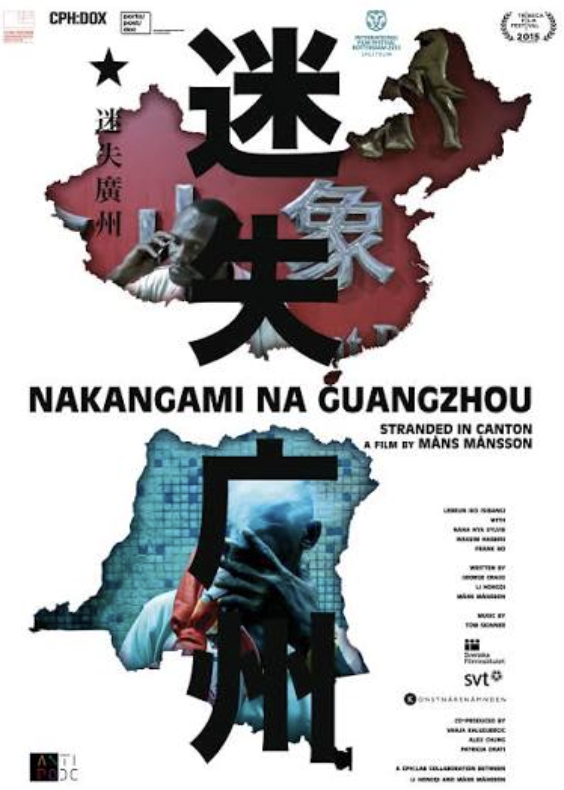
Congolese entrepreneur Lebrun travels to Guangzhou intending to produce political T-shirts for an election campaign back home. When the shirts are delayed and the election passes, he becomes stranded in the city with an expired visa, an increasingly useless business plan and a complicated personal life.
Månsson places a fictional character in the actual social world of Guangzhou’s African trading communities, largely improvising rather than working from predetermined dialogue. The result sits deliberately somewhere between documentary and fiction. Tribeca screened it in its narrative programme while emphasising its documentary elements.
Laisuotuo — Carl Houston McMillan (2016)
Africans in China / Chinese in Africa — short film
South African filmmaker Carl Houston McMillan tells two parallel migration stories: an African doctor living in China who encounters suspicion and rejection, and a young Chinese shopkeeper in Lesotho who faces hostility in his adopted community.
The title is the Chinese romanisation of Lesotho. Rather than beginning with investment figures, governments or geopolitics, the film focuses on the smaller humiliations and vulnerabilities produced by prejudice and racial profiling. Its symmetry is especially effective: both African and Chinese characters experience what it means to be made into an outsider.
Ultimate Hero — Cui Lei and Dragon Chen (2016)
Chinese popular imaginaries of Africa
A Chinese action adventure set in Africa, where protagonist Han Feng battles arms smugglers seeking control of a valuable energy resource.
As a representation of actual China–Africa relations, it is hardly subtle. That is precisely why films like this are useful. Africa becomes a cinematic landscape of dangerous resources, armed conflict and heroic Chinese intervention—a set of representational conventions that would become even more visible in subsequent Chinese blockbusters.
Wolf Warrior 2 — Wu Jing (2017)
Chinese popular imaginaries of Africa
Probably the most consequential Chinese fictional representation of Africa of the last decade.
The enormously successful action film sends former Chinese soldier Leng Feng into an unnamed African country engulfed by civil conflict and epidemic disease. Chinese citizens and vulnerable Africans must ultimately be rescued from armed violence.
Its extraordinary domestic success makes the film important well beyond its merits as an action movie. Wolf Warrior 2 helped crystallise a popular cinematic geography in which Africa becomes simultaneously dangerous, dependent and a stage upon which a newly powerful China can demonstrate military, humanitarian and moral capacity.
China Salesman — Tan Bing (2017)
Chinese popular imaginaries of Africa
Another action film in which an unnamed African country becomes the setting for a struggle involving telecommunications, mineral resources, civil war, Western conspiracy and Chinese technological intervention.
The plot follows a Chinese IT engineer attempting to prevent a European antagonist from manipulating conflict for control of strategic resources. It is perhaps more valuable as an artefact of how Africa is imagined in certain strands of Chinese commercial cinema than as an account of anything resembling everyday China–Africa relations.
When Africa Meets You / 非洲遇见你 — Yan Cui (2018)
Chinese in Africa
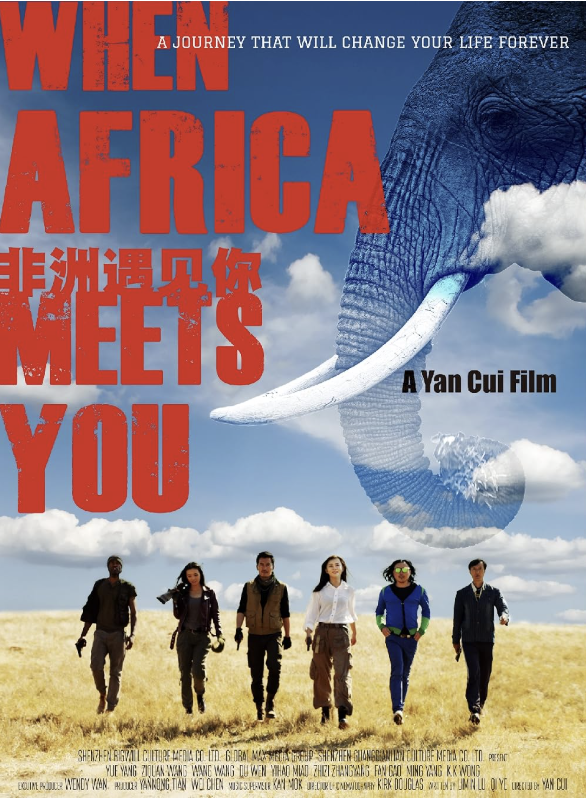
A Chinese adventure-romance filmed in Zimbabwe. A young Chinese woman becomes stranded while travelling in Africa and encounters poachers, mercenaries, diamonds and romance along the way.
Its mixture of tourism, danger, exotic landscape and romantic adventure makes it another useful example of Africa functioning as an imaginative space within contemporary Chinese popular culture.
My African Bride / 村里来了个洋媳妇 — Ren Yifei (2022)
African–Chinese families
A romantic comedy about a Chinese man who returns from working in Africa to his rural hometown with his Black African wife.
Much of the narrative is organised around the mother’s resistance to her son’s marriage, misunderstandings surrounding the new daughter-in-law and the eventual incorporation of the couple into village life. The film is particularly interesting as a popular-cultural representation of Black–Chinese marriage: its attempt to promote acceptance coexists with racialised humour and imagery that deserves critical attention.
Our Lady of the Chinese Shop / Nossa Senhora da Loja do Chinês — Ery Claver (2022)
Chinese in Africa
Angolan filmmaker Ery Claver offers something very different from the Chinese action-film tradition.
Set in Luanda, the film begins when a Chinese shopkeeper sells a plastic statue of the Virgin Mary said to possess miraculous qualities. The object moves through a neighbourhood populated by a grieving mother, a barber who establishes a religious cult and a boy seeking revenge for his missing dog.
Chinese presence is part of the urban world rather than the sole subject of the film. Commerce, religion, grief, desire and resentment become entangled in a distinctly Angolan story. The film premiered at Locarno in 2022.
Black Tea — Abderrahmane Sissako (2024)
Africans in China
Perhaps the most significant recent fictional treatment of African life in China.
Directed by Mauritanian filmmaker Abderrahmane Sissako, Black Tea follows Aya, an Ivorian woman who leaves Côte d’Ivoire and begins a new life in Guangzhou. Working in a tea shop, she develops a relationship with its Chinese owner, Cai.
The film places romance, migration and African social life at the centre of a fictional Guangzhou rarely seen in international cinema. It is particularly significant because the African neighbourhood is not merely background for a story about China. African migration, intimacy and the possibility—or impossibility—of belonging are the story.
Twenty years later
Looking across these films, one change is difficult to miss.
The visual archive used to be dominated by a relatively small repertoire: Chinese construction sites in Africa, African traders in Guangzhou, Western journalists asking whether China was the new colonial power, and endless attempts to decide whether China’s involvement in Africa was fundamentally good or bad.
Those questions have not disappeared. Nor has the Western gaze I complained about in 2016. But it no longer has the field quite so much to itself.
African filmmakers are representing Chinese migration. Chinese filmmakers are following African lives in China. African and Chinese directors are collaborating. Fiction films are imagining interracial intimacy and migration alongside spectacular—and sometimes troubling—fantasies of Africa. Cameras have moved from mines and presidential palaces into factories, markets, marriages, churches, apartments and phone screens.
And the shift extends well beyond documentary and cinema. Over the past decade, African content creators in China have increasingly begun producing their own audiovisual accounts of Chinese society and of their lives within it. On YouTube, Douyin, TikTok and other platforms, Africans are no longer simply people to be filmed, interviewed, explained or represented by journalists, filmmakers and researchers. They are also becoming narrators, performers, editors and distributors of their own representations of China.
This is part of a wider transformation in the cultural production of Africa–China relations. The question of representation is no longer simply whether an image of Africans or Chinese people is positive, negative or stereotypical. It is also about who has access to the means of representation, who controls the camera, who speaks directly to an audience, and whose account acquires visibility and authority.
Of course, self-representation does not somehow escape mediation. African creators operate within platform algorithms, commercial incentives, audience expectations and familiar genres, and they can reproduce some of the same racialised, spectacular or simplifying narratives found elsewhere. But something important has nevertheless changed. The SinoAfrican story is no longer being told primarily through governments, international broadcasters, documentary filmmakers and academic researchers. Increasingly, some of the people living these encounters are producing and circulating the stories themselves.
Seen from this perspective, documentaries, fiction films and platform videos form part of the same broader transformation: an uneven redistribution of the power to look, speak and narrate.
It is therefore no longer enough to ask what a film or video tells us about Africa–China relations.
We also have to ask who is looking, who is being looked at, who gets to speak, and who gets to tell the SinoAfrican story.


0 comments on “SinoAfrica on Screen: Documentaries, Feature Films and Short Films”