
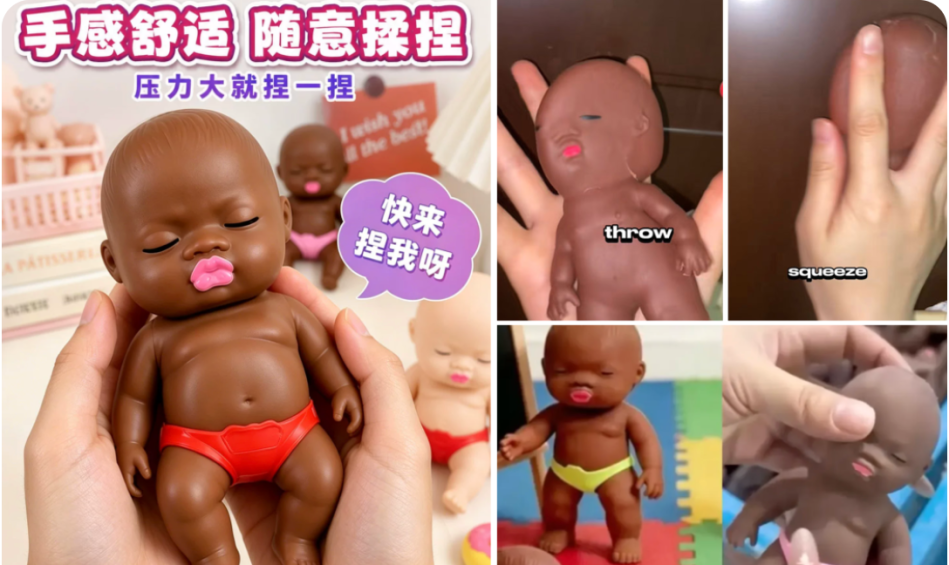
In the spring of 2026, a small rubber baby became one of the stranger viral sensations on Chinese social media. The toy, eventually known simply as “Natasha” (娜塔莎), was soft, stretchable and designed to be squeezed as a form of stress relief. But the version that became famous was also unmistakably dark-skinned, with exaggerated lips and other stylised features. Within weeks, videos of users stretching, throwing, stamping on, stabbing, cutting open and otherwise destroying the doll were circulating widely across platforms including Douyin and Xiaohongshu.
By June, the images had travelled well beyond China. Black commentators and advocacy groups described the videos as dehumanising and racist: a representation of a Black infant had effectively become an object onto which violence could be repeatedly performed for entertainment. CNN, TheGrio and other international media subsequently picked up the controversy, turning Natasha into the latest transnational debate about anti-Black imagery in Chinese popular culture.
It is an easy story to tell as simply another example of Chinese racism.
The actual genealogy of Natasha is more complicated—and, for that reason, perhaps more revealing.
The toy did not initially become famous as an explicitly racial provocation. In March 2026, a Guangdong content creator known as Cai Dabo (蔡大伯) began featuring the doll in videos about pressure from his family to marry. He jokingly presented the dark-skinned doll as his “mixed-race daughter” and named her Natasha. In one early video, his mother grabbed the doll and threw it to the floor; his exaggerated distress over the fate of “Natasha” became part of the joke. The clip attracted enormous attention and generated further videos in which he played the role of a single father caring for his imaginary daughter.
From there, however, the meme mutated.
Other creators began producing increasingly extreme videos in which the doll was crushed, injected with water, pierced with needles, cut apart or violently thrown around. Sellers quickly incorporated the trend into advertising, promoting the doll with language emphasising how much abuse it could withstand. Chinese reporting in May and June focused heavily on this transformation of a stress toy into what critics described as simulated violence against an infant-like figure. Concern centred particularly on children reproducing the behaviour and on sellers using violent or sexualised imagery to generate clicks and sales.
Chinese authorities and consumer organisations responded accordingly. Some schools prohibited the toy, e-commerce platforms removed violent promotional videos, and China’s market regulator called on major platforms to strengthen oversight of stress-relief products. The Chinese Consumers Association also warned that violent and sexualised marketing could violate existing regulations.
What is striking, however, is that race was largely peripheral to the initial Chinese discussion.
Domestic criticism was about children, violence, vulgarity, product safety and platform regulation. Outside China, meanwhile, the racial dimension was difficult to miss. The object being stabbed, crushed and thrown against walls looked like a Black baby.
These are not necessarily mutually exclusive interpretations.
The question is not simply whether the person who manufactured the original toy intended it to be racist, or whether everyone who squeezed Natasha consciously imagined themselves attacking a Black child. Intent provides only part of the answer. Racial meaning is also produced through form, repetition, circulation and context.
Natasha had already been racialised before the most violent videos appeared. The original viral joke explicitly described the dark-skinned figure as the creator’s “mixed-race daughter.” Chinese lifestyle coverage repeatedly described the doll through its dark skin, thick lips and deliberately “ugly-cute” appearance. The humour depended partly on the incongruity of this unusual child appearing within a story about marriage, reproduction and family expectations.
Once thousands of videos transformed that same Black-looking body into something to be squeezed, beaten and destroyed, it is hardly surprising that Black viewers encountered the images differently.
This is precisely where the Natasha controversy becomes useful for thinking about race in contemporary China. The most interesting question is not “Is Natasha racist: yes or no?” It is how a fairly banal commodity can acquire racial meaning as it moves between creators, audiences, commercial platforms and different interpretive contexts.
The episode also sits uneasily alongside a longer history of controversies discussed on this site—from the Qiaobi detergent advertisement and televised blackface to the more recent exploitation documented in Racism for Sale. What has changed is the infrastructure of circulation. The racial image no longer needs to originate in an advertising agency or a national television broadcast. It can emerge from the interaction between an inexpensive commodity, a viral joke, thousands of imitators, e-commerce sellers and algorithms rewarding increasingly spectacular content.
In Racism for Sale, the racial insult was explicit: African children were made to repeat racist Chinese phrases for paying customers. With Natasha, racialisation is murkier. There is no single author, message or moment at which the object definitively “becomes racist.” Instead, racial meaning accumulates as the image circulates.
Perhaps that is precisely what makes the case worth watching.
Platforms do not merely circulate representations. They can transform them. An odd-looking stress toy becomes a fictional daughter; the fictional daughter becomes a meme; the meme becomes a commodity; violence against the commodity becomes content; and that content eventually encounters audiences for whom the Black body being repeatedly damaged carries a very different historical weight.
The Natasha doll may therefore tell us less about whether individual Chinese users consciously “hate Black people” than about something broader: how racialised images can be produced collectively, commercially and almost accidentally within contemporary platform culture—and how difficult it becomes to separate humour, commerce, violence and race once those images begin to travel.


0 comments on “The Natasha Doll Controversy: When Does a Viral Trend Become a Racial Image?”