
Liu, Xinyi, Qiang Zhang and Ning An. 2026. “Reimagining Africa on Chinese social media: Everyday visualities and a horizontal gaze on Xiaohongshu.” Journal of Asian and African Studies. First published online 30 July 2026.
For those of us who have been following representations of Africa in Chinese media for years, one of the most persistent questions has been whether the visual vocabulary is actually changing.
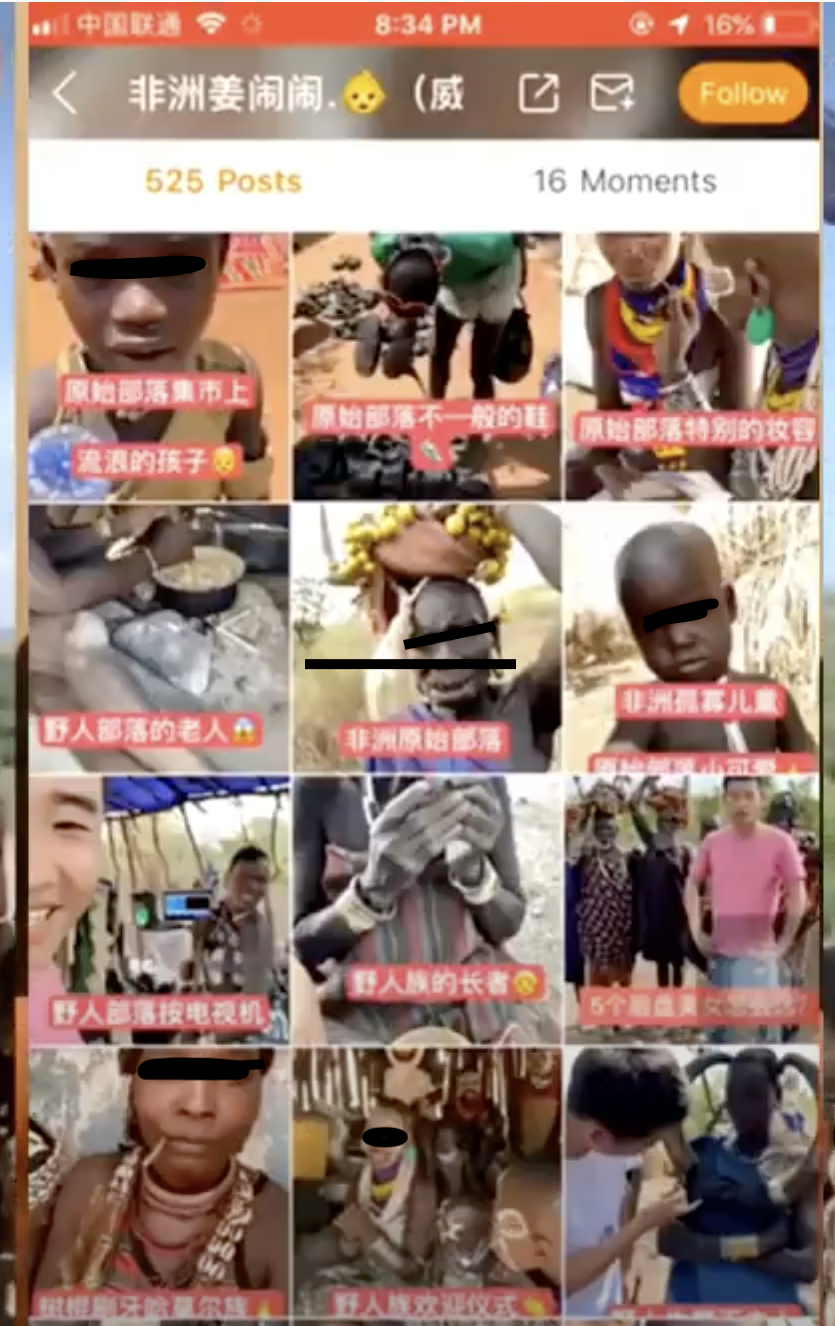
The familiar repertoire hardly needs rehearsing: poverty, wildlife, tribalism, underdevelopment, grateful recipients of Chinese assistance, occasionally interrupted by spectacular images of danger or racial difference. Much of the scholarship on Chinese representations of Africa has understandably concentrated on these images and the hierarchies they reproduce.
A new article by Xinyi Liu, Qiang Zhang and Ning An suggests that something else may now be happening on Chinese social media.
The authors examine 156 user-generated short videos on Xiaohongshu (小红书), one of China’s major lifestyle and social-media platforms. Through critical discourse analysis, they identify what they call a “horizontal gaze”: representations of Africa organised less around spectacle and deficiency and more around such mundane concerns as work, travel, local knowledge and everyday experience. Africa, in these videos, becomes somewhere people navigate rather than simply somewhere they look at.
This does not mean that stereotypes have disappeared. The authors explicitly note the continuing presence of images of poverty and underdevelopment. Their argument is instead about a shift in emphasis: alongside familiar representations, Xiaohongshu appears to be producing a more grounded visuality based on personal encounters and practical experience.
That distinction is important.
Only a few weeks ago, we discussed research showing how Chinese social-media platforms can turn racial imagery into a commodity: spectacular, emotionally charged representations of Africans circulated because those representations attract attention, engagement and ultimately money. The Xiaohongshu study offers a useful corrective. Chinese digital culture is clearly not producing a single image of Africa. The same platformisation of representation that can amplify crude stereotypes can also create space for considerably more ordinary accounts of African places and everyday life.
And perhaps ordinary is the important word here.
One of the persistent problems with representations of Africa—not only in China—is precisely the difficulty of allowing African life to be unremarkable. Africa must continually signify something: poverty or authenticity, danger or opportunity, backwardness or rapid development, China’s benevolence or China’s new colonialism. A video about finding a restaurant, navigating a neighbourhood, going to work or figuring out how something locally operates may therefore seem politically insignificant. Yet it can quietly undermine the assumption that Africa exists primarily as an object through which outsiders tell larger stories about civilisation, development and geopolitics.
The notion of a “horizontal gaze,” however, is worth approaching cautiously.
A camera becoming more intimate or everyday does not automatically make the relationship behind it horizontal. Chinese creators still arrive with particular forms of mobility, purchasing power, technological access and representational authority. Platforms themselves decide which encounters become visible, while creators learn quickly what kinds of difference travel well algorithmically. The tourist searching for the “real Africa,” the expatriate offering insider knowledge and the lifestyle creator explaining local customs may produce considerably more nuanced representations than state television or sensational journalism while still occupying an unequal position in relation to the people and places being represented.
In other words, moving from the spectacular to the everyday does not make power disappear.
But this is precisely why this article is useful. Rather than asking once again whether Chinese representations of Africa are simply “positive” or “negative,” it draws attention to changes in who is producing images, through what platforms, and through what kinds of encounter.
There is an interesting parallel here with developments on the other side of the Africa–China encounter. African content creators living in China are also increasingly producing their own everyday accounts of Chinese life. Their videos are frequently about food, work, relationships, shopping, travel, language and precisely the kinds of mundane encounters that disappear when Africa–China relations are viewed only through diplomacy, infrastructure or racial controversy.
These two developments are not identical. Nor do they suddenly create an egalitarian SinoAfrican mediascape. But taken together, they point toward a broader transformation in the cultural production of Africa–China relations. Governments, news organisations and documentary filmmakers no longer have anything resembling a monopoly over the visual field. Increasingly, people involved in the encounter are producing representations of the encounter themselves.
The result may not always be a genuinely “horizontal” gaze. But it certainly makes the old vertical picture considerably harder to maintain.


0 comments on “New Research: Beyond the Stereotype? Reimagining Africa on Xiaohongshu”