
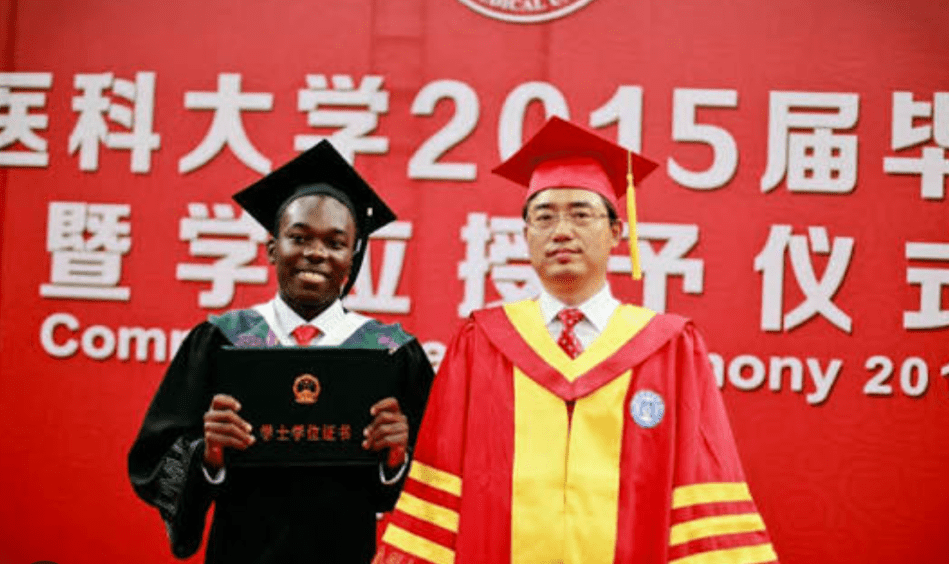
A short review of Daisy Binfang Wu, “How Post-Study Plans Project Into Onward Mobility Trajectories: Compromise, Attunement and Migrant Subjectification in (Re-)Routing Post-Study Migration of African Migrant Students in China,” Population, Space and Place (2026).
For many years, research on Africans in China has challenged the assumption that migration is necessarily a linear movement from one country to another followed by settlement. Work by scholars such as Heidi Østbø Haugen, Adams Bodomo, Shanshan Lan, Gordon Mathews and others—and research published through AfricansinChina.net—has instead shown the importance of circulation, transnational trading routes, temporary stays, onward movement and sometimes enforced immobility for understanding African presence in China.
A new article by Daisy Binfang Wu in Population, Space and Place brings some of these questions into the rapidly growing world of African student migration to China. Rather than asking African students where they plan to go after graduation, Wu follows what happens when those plans encounter the rather less cooperative realities of visas, money, employment and immigration regimes.
The distinction matters.
International student mobility is often narrated as a sequence of choices: study abroad, graduate, find employment, return home or move somewhere else. Wu’s longitudinal ethnographic research shows trajectories that are considerably messier. African students may arrive in China imagining one future and find themselves repeatedly adjusting their plans as different possibilities open and close.
One of the stories through which the article makes this particularly clear is that of Eddie, a Ghanaian student whom Wu followed over several years. After his master’s degree in China, Eddie hoped to continue his career in the United States. When he was unable to secure the resources necessary for that move, he remained in China and pursued a PhD instead. After completing the doctorate, he tried unsuccessfully to find an academic job and eventually returned to Ghana when his student visa expired.
That might appear to be the end of his China story.
It wasn’t.
Several months later, Eddie returned to China after obtaining a position as a lecturer at a private university. His trajectory—Ghana to China, attempted onward migration, further study in China, return to Ghana, then migration back to China—is precisely the kind of movement that disappears when migration is reduced to categories such as “stay,” “leave” and “return.”
Wu identifies two recurring obstacles in the trajectories of the students she followed. Those hoping to remain in China frequently encounter limited employment opportunities and an immigration system that offers relatively few straightforward routes from international student to migrant worker. Those hoping to use China as one stage in an onward trajectory—often towards Europe or North America—may instead find their movement constrained by money, visas and other resources. The result can be an unwanted return home or what Wu describes as a “second state of immobility” in China.
This is where the article connects particularly well with the longer literature on African mobility in China. Some of the earliest research on African traders in Guangzhou showed that the categories commonly used to understand international migration did not adequately describe people whose lives were organised across multiple places. Traders could spend weeks or months in Guangzhou, return to Lagos, Accra or elsewhere, and later come back to China. Others developed much more durable forms of emplacement while remaining deeply embedded in transnational networks.
African students are obviously not African traders, and their trajectories are structured by a rather different set of institutions. But Wu’s research suggests an important continuity: being in China does not necessarily mean migrating to China in any conventional sense.
China can instead become one node in a much longer trajectory.
There is another important dimension to this story. China has spent considerable resources over the past two decades attracting African students, particularly through scholarships and the broader expansion of China–Africa educational cooperation. The number of African students studying in the country consequently grew dramatically before the pandemic. Yet attracting students and creating viable post-graduation pathways for them are two very different things. Wu’s research exposes the tension between China’s emergence as a major destination for African higher-education mobility and the limited possibilities many graduates encounter if they subsequently want to build a life and career there.
This also complicates some of the celebratory language surrounding South–South mobility. Moving from an African country to China may provide educational opportunities that would otherwise have been unavailable, but it does not remove the hierarchies governing global mobility. Indeed, the desire of some participants to move subsequently towards the Global North reminds us that mobility itself remains highly unequal: some passports, qualifications and bodies travel much more easily than others.
Perhaps the most useful contribution of Wu’s article, however, is its refusal to treat these constraints as producing predictable outcomes. Students continually reassess their situations. They compromise, wait, change direction, pursue another degree, return home, try another country—or, like Eddie, unexpectedly find their way back to China.
For those of us who have studied African mobility in China for a long time, there is something very familiar here. For years, journalists and researchers have asked whether Africans in China are staying or leaving, as though answering that question would tell us whether African migration to China has succeeded, failed, grown or disappeared.
Wu’s research on a newer generation of African migrants suggests that we may still be asking the wrong question.
The more interesting question is not simply whether people stay or leave China, but where China sits within much longer and continually changing trajectories of African mobility.


India has also done a lot to attract African students. Comparative research would be interesting.
https://aca-secretariat.be/newsletter/india-offers-new-opportunities-for-study-to-african-students/