
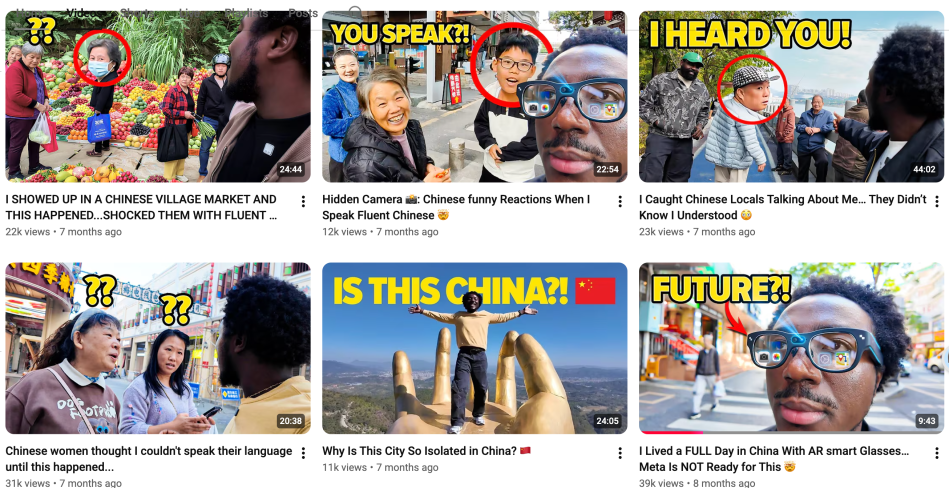
For those of us who have been following Africans in China for years, there is something striking about scrolling through YouTube, TikTok or Instagram today. The visual archive of African life in China is increasingly being produced by Africans themselves.
This might sound obvious. It isn’t.
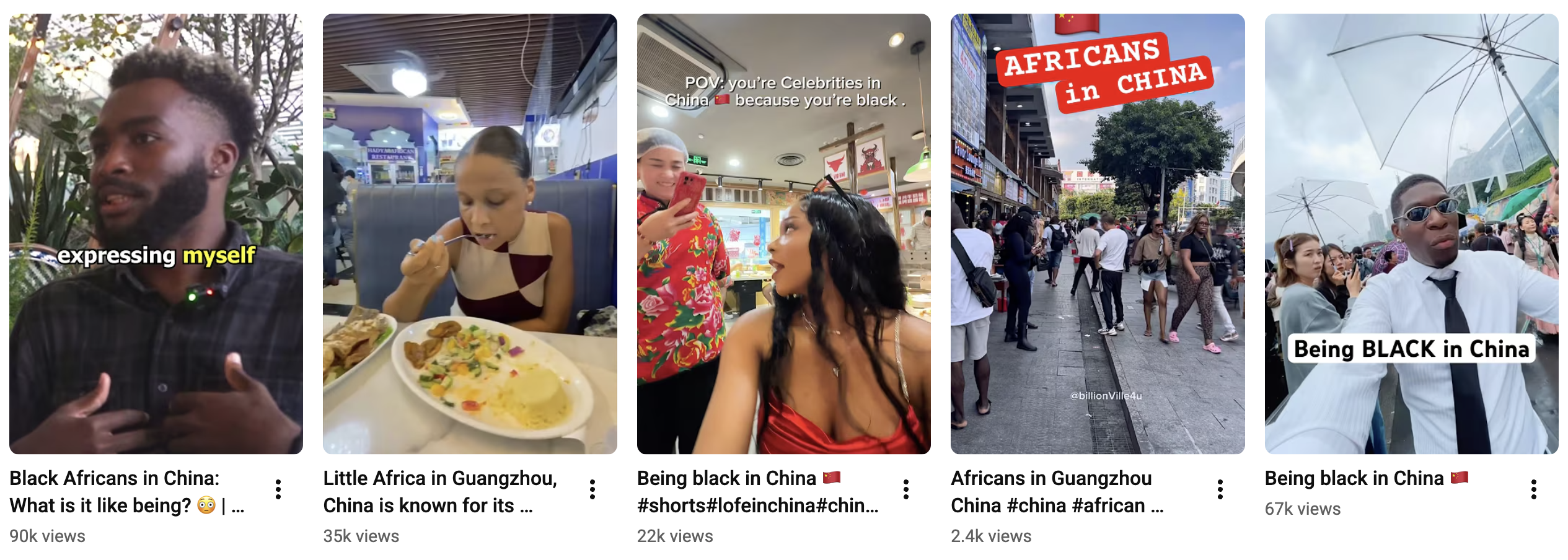
When I first started researching Africans in China more than fifteen years ago, much of what circulated visually about African communities was produced by somebody else: Chinese and international journalists, television crews, documentary filmmakers, researchers, and occasionally curious passersby. Africans appeared in these stories, sometimes speaking for themselves, but they rarely controlled the camera, the editing, the title, the thumbnail, or the circulation of the resulting image.
Today, African creators walk through Chinese streets holding cameras. They approach strangers. They speak Mandarin. They enter people’s homes and cook with them. They review Chinese cars and apartments. They document marriages, children and family celebrations. They travel between China and Africa. They encounter racism. And they turn all of this into content watched by hundreds of thousands—sometimes millions—of people all over the world.
That is more than a change in representation. It is a change in who gets to produce the archive.
I have been thinking about this while working on a new article, Situated Encounters: African Content Creators and Their Digital Presence in China. The research follows three creators—Ghanaian Fel Thommy, Nigerian Jerry in China, and Cameroonian Mike Raynaldo—and draws on more than a thousand videos across YouTube, TikTok, Instagram and Chinese social media platforms.
What interested me was not simply what these creators say about China. It was the remarkably persistent narrative form through which they tell their stories: the encounter.
A Black man walks down a Chinese street…
Anyone who has spent time watching African creators in China will recognise the formula.
A Black man walks through a Chinese street, market or park. He approaches somebody or says something in Mandarin. There is hesitation. Then surprise. Sometimes laughter. Sometimes applause. A conversation begins.
Where are you from?
How can you speak Chinese?
How did you learn?
Why are you here?
Occasionally the questions become more explicitly racial: why are you Black? Why do Africans look different? At other times race is never mentioned, but it remains somewhere in the background of the surprise.
Jerry in China provides some particularly fascinating examples.
In one video, Jerry walks through Beijing casually speaking Mandarin to strangers. People laugh, stare and applaud. Jerry explains that he learnt Chinese not from textbooks but “in the street.”
In another, he sits down beside Chinese construction workers at a noodle stall. One of the men tells him that Chinese and Africans are fundamentally different because they do not look alike.
Jerry doesn’t launch into a lecture on racism. Instead, he jokes with the man.
How many eyes do you have?
How many noses?
Do you eat?
So do I.
Everyone laughs.
It is a tiny interaction. But this is precisely what makes it interesting. Jerry takes an assertion of racial difference and, through Mandarin, humour and a deliberately mundane discussion of bodies and eating, redirects the conversation towards commonality.
Then there are videos in which Jerry moves beyond the street altogether. In one, he enters the home of a Chinese family and spends the afternoon cooking with them. What begins with the novelty of an African man preparing Chinese food gradually becomes a conversation about foreigners, children, racial difference and representations of Africa. Jerry challenges videos that present Africa primarily through poverty and offers his hosts a different account grounded in his own upbringing.
Eventually, everybody sits down and eats.
Street. Noodle stall. Home.

The encounters are different, but the narrative building block remains remarkably consistent: people are brought together, an expectation is exposed, something happens between them, and some form of recognition, disagreement, laughter, discomfort or connection follows.
But the African doesn’t always remain the object of curiosity
Fel Thommy’s videos take this in another direction.
Fel is Ghanaian, speaks Mandarin and is based primarily in Shenzhen. He originally came to China as a student and has since become an entrepreneur and a major content creator, with hundreds of thousands of followers across YouTube, TikTok and Instagram.
Many of his earlier videos contain the now-familiar encounter: Chinese people are surprised that a Black African man speaks fluent Mandarin.
But something interesting happens as Fel’s digital presence develops.
The object of curiosity begins to shift.
In a long travel video through Henan, for instance, Fel talks with drivers, food vendors, shoppers and other residents. The moments when people react to his Mandarin make excellent titles and thumbnails—and Fel knows this. But most of the actual video is about something else: local food, dialects, neighbourhoods, employment, commerce and everyday life.
Increasingly, Fel becomes less the surprising object being encountered and more the person through whom his viewers encounter China.
He reviews a Xiaomi electric vehicle. He tours apartments in Shenzhen and discusses rents, neighbourhoods and lifestyles. He explains technologies and consumer practices. And increasingly he travels beyond China.
One of the most revealing videos takes us all the way back to Ghana.
Fel meets Nathaniel, an old school friend whom Fel had originally inspired to travel to China. Nathaniel eventually returned to Ghana and moved into business and property development. The two walk through his projects while discussing China, Ghana, migration, investment and what Africans might do with the knowledge and resources accumulated abroad.
At one point Nathaniel says:
“Nobody will come and build Africa for us unless we build it.”
There is something important happening here that conventional migration stories don’t always capture.
China is not necessarily the final destination. Nor is the trajectory Ghana → China simply an African variation of the familiar story in which migration ultimately means reaching and settling in a Western metropolitan centre.

People move. They return. Capital moves. Knowledge moves. Commodities move. Aspirations move.
China becomes one node in a much larger South–South geography.
Belonging is never quite finished
Mike Raynaldo’s videos complicate things further.
Mike is Cameroonian, lives in China, speaks Mandarin, is married into a Chinese family and has a young daughter. His videos move constantly between racial visibility and an extraordinarily ordinary form of embeddedness in Chinese life.
In one video, Mike attends the 100th birthday celebration of his wife’s grandmother with more than 200 relatives and guests. He receives family members, collects hongbao, talks with relatives, sings for the grandmother and looks after his daughter.
Nothing particularly dramatic happens.
And that is precisely the point.
Here is a Black African man in China not primarily appearing as “the African,” “the foreigner,” or an example of Sino-African relations. He is a husband, father, grandson-in-law and member of an extended family.
Then, in another video, Mike enters a residential compound to look at an apartment.
Suddenly everything changes.
Residents and a security guard challenge his presence and eventually call the police. Mike explains in Mandarin that he has permission to be there. This time, speaking Chinese doesn’t magically resolve the encounter.
What I find especially interesting is what Mike does afterwards.
He makes another video.
Walking through his neighbourhood, talking to elderly residents, buying fruit and chatting with strangers, he reflects on the earlier incident. He refuses both easy interpretations. He does not pretend that discrimination didn’t happen, but he also refuses to make one discriminatory encounter stand for “China.”
As he puts it, the bad encounters are also part of what makes his “Black in China stories complete.”
This seems to me much closer to the messiness of belonging than either of the narratives we are so often offered: China as irredeemably racist, or China as a harmonious space of Sino-African friendship.
Neither is particularly useful for understanding a man who can be a completely ordinary member of a Chinese family on Saturday and an unwelcome Black foreigner in a residential compound on Monday.
I have been calling this recognition with friction.
We have spent a lot of time talking about racism
There is a larger issue here.
For very good reasons, scholarship on Africans in China has spent considerable time examining race and racism. Shanshan Lan’s work, Bodomo’s work, Gordon Mathews and colleagues’ research in Guangzhou and Hong Kong, and a growing literature on anti-Blackness and Chinese digital cultures have demonstrated that racialisation matters enormously for understanding African experiences in China. My own work has been part of that conversation.
And race is everywhere in these videos too.
It is there when somebody is astonished that Jerry speaks Mandarin. It is there in the hesitation when Mike approaches strangers. Sometimes it is explicit, as when Jerry’s construction worker tells him Africans and Chinese are fundamentally different.
But after watching hundreds and hundreds of these videos, I increasingly think that beginning and ending with racism produces another problem.
It allows racialisation to determine what African lives in China can narratively be about.
The creators themselves don’t do that.
Their videos contain discrimination, but they also contain cooking, children, marriage, friendship, cars, apartments, technology, entrepreneurship, restaurants, holidays, shopping, parents, jokes, bad days and boring days.
This matters.
There has been a tendency—both in media reporting and sometimes in scholarship—to understand African agency primarily through resistance: Africans experience racialisation, and therefore agency consists in resisting stereotypes, challenging racism or producing counter-representations.
Those things certainly happen.
But perhaps choosing to tell a story about taking your parents to a resort, reviewing a Chinese electric car, cooking fish with your neighbour or watching your daughter eat noodles with chopsticks is also consequential.
Taken together, these hundreds of videos are becoming something we didn’t really have fifteen years ago: an expanding archive of Black life in contemporary China produced substantially by Africans themselves.
In that archive, race can be central.
It can also be peripheral.
And sometimes, for a while, it can be remarkably unimportant.
The encounter has become platformable
There is another side to all of this that I think deserves much more attention.
These encounters do not simply happen and magically appear online.
Creators recognise them, film them, edit them, title them, make thumbnails for them, cut them into shorter clips and circulate them across platforms. A fleeting conversation on a street can become a story consumed by hundreds of thousands of people.
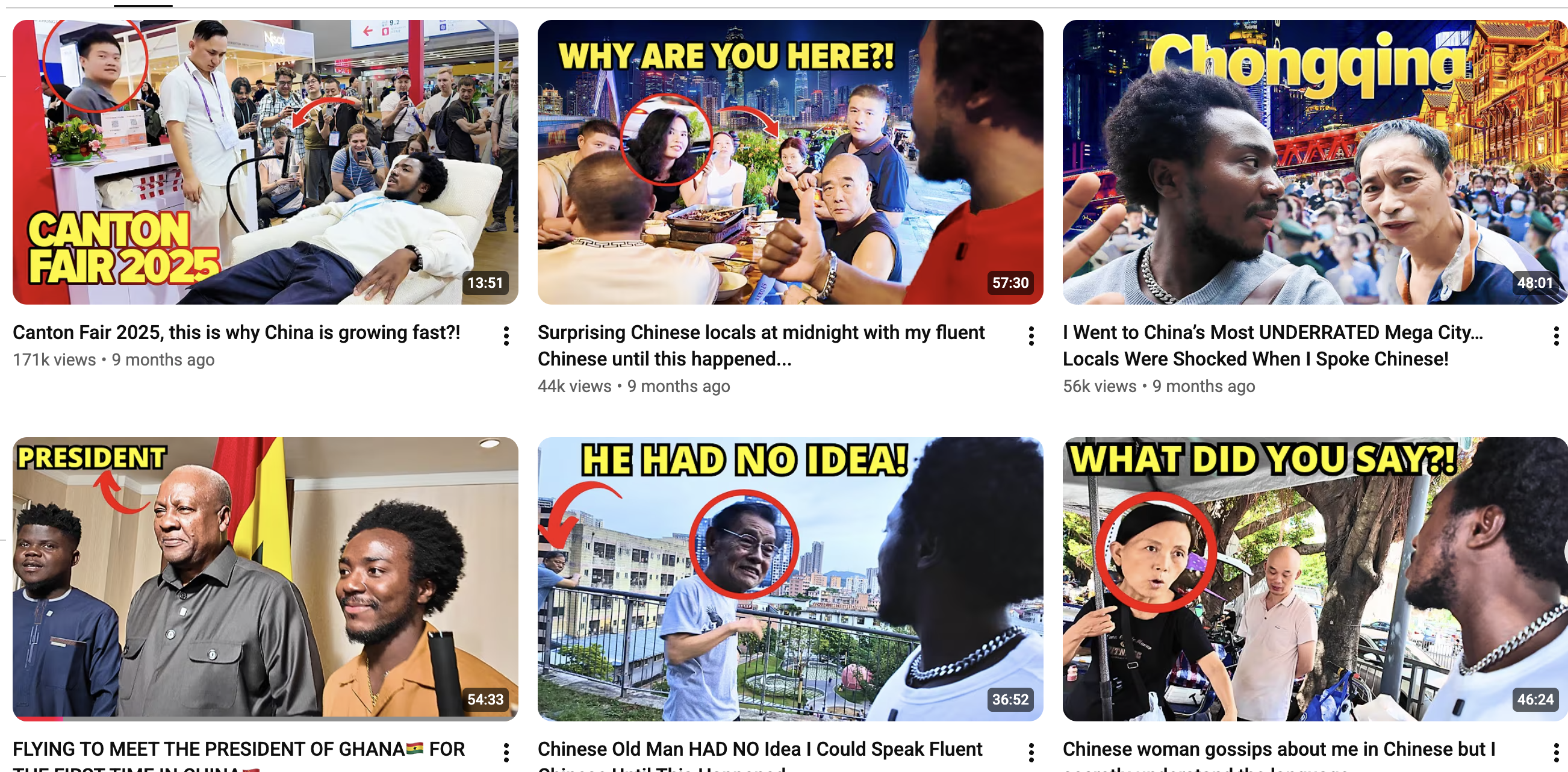
The encounter is particularly suited to this.
Someone approaches someone else. There is an expectation. Something unexpected happens. Somebody laughs, becomes uncomfortable, disagrees, changes their mind or walks away.
In other words, the encounter already contains the skeleton of a story.
It is platformable.
And creators learn how to recognise this.
Fel provides a wonderful example. A moment of surprise about his Mandarin might occupy only a minute or two of a thirty-minute travelogue, but that moment can become the thumbnail and title that gets people to click on a much broader story about Henan.
This doesn’t necessarily make the encounter “fake.” The distinction between spontaneous and staged interaction is less interesting to me than what happens afterwards: an everyday social interaction is transformed into cultural production.
And, of course, sometimes monetised.
Something else has changed in China
There is a final question that I haven’t fully answered yet.
For those of us who have been studying China for a long time, the sheer normality of these videos is itself remarkable.
Think about what is happening.
A foreigner walks through a Chinese neighbourhood carrying a camera. He films strangers. He approaches people and interviews them. He enters markets, residential areas, restaurants and shops while recording. Nobody finds the presence of the camera itself particularly extraordinary.
That was not always the case.
China’s public spaces have changed enormously alongside smartphones, livestreaming, Douyin, Kuaishou and the massive expansion of everyday video production. Taking a camera into certain public environments could once make a foreigner conspicuous very quickly—and, depending on the place and moment, attract unwanted attention from security personnel or police (memories from my Guangzhou research days).
Today, millions of Chinese people are themselves filming, livestreaming and producing content in public.
That technological and cultural transformation has changed the conditions under which African creators can produce their stories.
We therefore also need a history of the camera in the encounter.
When did it become normal to walk through Chinese public space continuously filming? How has livestreaming altered people’s willingness to be recorded by strangers? Does a Black foreigner holding a smartphone now become legible not simply as a foreigner with a camera, but as another content creator? And how uneven is that freedom across different Chinese spaces?
I don’t yet have answers to those questions.
But I suspect the history of African digital presence in China will eventually have to be connected to this much larger transformation of Chinese public space.
Who gets to tell African life in China?
Africans in China have been researched extensively over the past two decades. They have also been photographed, interviewed, counted, categorised and endlessly explained.
Some of that work—including work by scholars who have spent years with African communities—has transformed what we know about migration, trade, race and transnational life between Africa and China.
But something else is happening now.
The people who once predominantly appeared inside other people’s accounts of Africans in China are increasingly producing enormous archives of their own.
We should not romanticise those archives. They are commercial. They are algorithmically shaped. Surprise sells. Racial difference can generate clicks. Creators know this. Nor do these videos somehow demonstrate that racism has disappeared, that everyone belongs, or that everyday encounters inevitably generate understanding.
Mike’s experience looking for an apartment should make that abundantly clear.
But neither should we reduce these creators to digital evidence for a debate about whether China is or is not racist.
They are doing something considerably more interesting.
They are making African presence in China visible, circulable, narratable—and monetisable—on their own terms, one encounter at a time.


0 comments on “When the encounter becomes the story: African content creators narrating life in China”