
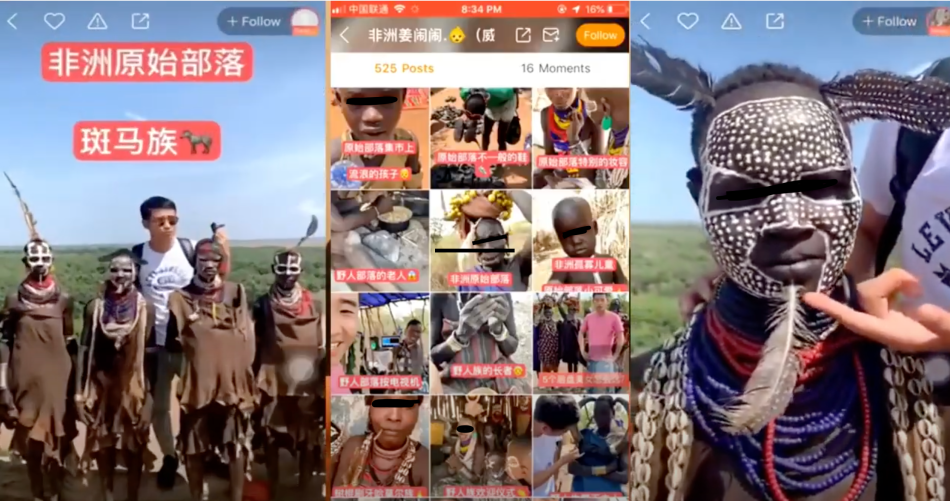
A short review of Thomas Ameyaw-Brobbey, “Exploiting New Public Diplomacy to Sell Racism: Chinese Representation of Africans in China’s Social Media Space,” Politics & Policy 54(5), 2026, e70175.
A new article by Thomas Ameyaw-Brobbey takes on a disturbing but increasingly familiar feature of China–Africa relations: the circulation of demeaning, stereotypical and sometimes explicitly racist representations of Africans through Chinese digital media.
The study analyses 716 Africa-related videos selected from Douyin and Youku, combining cybernography with systematic content analysis. Ameyaw-Brobbey argues that Chinese non-state actors operating in Africa have used the expanded spaces of what he calls “new public diplomacy” to produce and circulate large volumes of distorted imagery about Africans. These representations, he argues, do not simply reflect prejudice. They help produce and reinforce it. (Wiley Online Library)
This is not an entirely new problem. Chinese digital representations of Africa have been attracting attention for well over a decade, and earlier work has already examined the ways Africa becomes associated online with poverty, primitiveness, disorder, sexuality and racial difference. What has changed is the scale, speed and commercial infrastructure through which those images now circulate.
That shift matters.
A racist joke told between friends and a racist video produced for hundreds of thousands of viewers are not quite the same social object. Platforms turn representation into circulation, circulation into visibility, and visibility—sometimes—into money. Racism can therefore become not merely an attitude but a form of content.
The most disturbing example is one already familiar to many readers of this site. Ameyaw-Brobbey explicitly draws on the BBC Africa Eye documentary Racism for Sale, which exposed Chinese-run video operations in Africa where African children were instructed to repeat phrases in Chinese they often did not understand, including openly racist material.
What makes that case particularly unsettling is precisely its banality. It does not require some grand ideological apparatus producing anti-African propaganda from above. A camera, a platform, an audience and a commercial incentive can be enough.
Ameyaw-Brobbey’s contribution is to place such practices within a wider argument about public diplomacy. Much of the literature on China–Africa media has focused on the Chinese state’s attempts to improve China’s image in Africa through broadcasting, development narratives, cultural exchange and “people-to-people” relations. This article reverses the direction of the lens. It asks what happens when Chinese citizens, entrepreneurs and content producers in Africa become producers of images about Africa for audiences back in China.
The answer is not especially flattering.
The article argues that these non-state representations can coexist awkwardly with official narratives of China–Africa friendship and, in some instances, receive what the author describes as indirect or passive endorsement from state institutions.
There are, however, some reasons to be cautious about how far we take the argument.
A purposive sample of 716 videos is substantial, but Douyin and Youku are not “Chinese social media” in its entirety. Bilibili, Kuaishou, Weibo, Xiaohongshu and other platforms have their own audiences, genres and economies of visibility. Nor does analysing circulating representations tell us straightforwardly what “the Chinese public” thinks. Content is not reception. A racist video can be watched, mocked, condemned, ignored, shared ironically or believed.
More strikingly, the article sits somewhat apart from the now extensive scholarship on Africans actually living in China. Its references include important work on race, Chinese nationalism and representations of Africa, but much of the research produced over the past two decades on African migration, racialisation and everyday life in Guangzhou and elsewhere—by scholars including Shanshan Lan, Heidi Østbø Haugen, Gordon Mathews, Adams Bodomo and others—is largely absent.
That absence matters because digital representations of Africans do not emerge in a vacuum. They intersect with much older racial imaginaries, but also with decades of actual encounters between Africans and Chinese people—in markets, universities, neighbourhoods, marriages, workplaces and online spaces.
And those encounters do not always reproduce the images circulating on platforms.
This is perhaps where the next step in the research lies. The interesting question is no longer simply whether racist representations of Africa exist online. Clearly they do. Nor is it particularly surprising that platforms can amplify them.
The harder question is how these representations interact with lived encounters.
What happens when someone who has consumed years of stereotypical Africa-related content meets an African colleague, neighbour, student, customer or spouse? What happens when African creators in China begin producing their own counter-images for both Chinese and international audiences? And what happens when the subjects of representation themselves become platform producers?
For those of us who have been following Africans in China for years, that is where the story is becoming particularly interesting.
The racism is real.
But so is the struggle over who gets to represent whom.


0 comments on “New Research: Selling Racism: Africa in China’s Social Media Economy”